The question many marketers are trying to answer now, is “Who do people trust?”
I’ve been spending more and more time pouring over data, medium usage, behavioral and preference data for clients, and am learning more and more about how humans behave on the web.
So who do people trust? Three research studies indicate it’s peers, or people they know. And social clout from bloggers, or those with a lot of online friends ain’t it.
1) Forrester Research
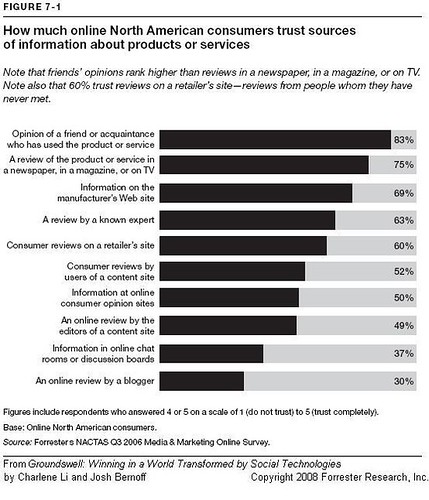
What’s interesting is that colleague Josh Bernoff’s weekly post on who do people trust, indicates that people trust their peers the most, and bloggers last. Josh writes:
“What does this mean for your brand? It means that a focus on “influencers” is not enough. You never know who may be reviewing your product, or where. Influencers may touch a lot of people, but so do the masses of reviewers on Yelp, or Amazon.com, or TripAdvisor. And heaven forbid you get people talking about your brand on The Consumerist.”
If people trust the reviews of friend that they know and trust 14% more than your corporate website, what is your web marketing team doing to accommodate this? Are you spending 14% more effort to listen, learn, influence peer reviews? I’ll bet your not, as most brand marketers I know are spending time building microsites, and launching brochure ware on their sites, without think about the impacts of their corporate website becoming irrelevant.
2) Edelman Trust Barometer

In a confirming correlation, Edelmen’s research from Steve Rubel indicates the exact same findings, despite different phrasing of the questions. Steve writes: “both marketers and publishers – continue to focus on reach, they are missing the big picture. Trust is by far a more important metric, one that clearly rules when it comes to influence.”
3) Pollara Research
Steve points to a third research report also validating this claim. Research firm Pollara found similar results:
“According to a new study from Canadian research firm Pollara, self-described social media users put far more trust in friends and family online than in popular bloggers, or strangers with 10,000 MySpace “friends.”
Of more than 1,100 adults polled in December, nearly 80% said they were very or somewhat more likely to consider buying products recommended by real-world friends and family, while only 23% reported being very or somewhat likely to consider a product pushed by “well-known bloggers.”
“This shows that popularity doesn’t always equate to credibility,” said Robert Hutton, executive vice president and general manager at Pollara. “Marketers might have to reconsider who the real influencers are out there.”
What you should do
Forward this post back to your marketing team, encourage the team to have an active and open dialog. Should you be focusing in on influencers only in your market space? Or should you start also focusing on ratings and review sites, where customers are critiquing, reading, and making decisions based on each others data.
So what’s this mean for me? Unless you know me, you’ll probably trust your friends or family far more than my opinion.
So how can I win your trust back? Lately, I’ve been starting to see the cracks in social media, and have started a tag on this blog called Challenges. Social media isn’t perfect, it’s new, and many people and brands are doing it wrong. It’s important to be objective and point out when it works and when it doesn’t.
Update: Am I looking in the rear view mirror? intersting audio podcast debating this post, listen in (around 20 minutes in)

Another great post Jeremiah.
I think people (I like to call them people rather than users or customers) will trust less and less bloggers because brands are corrupting the natural meaning of blogs. Many people can perceive if behind a blog there is a brand to pilot or influence posts!
Same problem with ratings and reviews. In theory they are a great way to show transparency from a brand, but brands should be bold enough to show on their corporate sites good and bad reviews! So, the question is: how many brands are brave enough to do so? And, don™t you think brands would be more inclined to influence reviews? Just few of the brands I know are really transparent about these tools, and one of these is Dell.
Sometimes we struggle behind measurement and how to build trust, etc¦but if we start thinking to audiences as People, we might be surprised by the fact that people are US, and We DO trust our friends because we know them¦so, where™s the surprise?
Maria Teresa
I see Jeremiah, you hold the truth, but you are trying to get more out of the posts…clever 🙂
Maria-Teresa
I was joking!
Interesting post Jeremiah!
I think it is interesting to know WHY we trust our friends more than companies. I think this might be due to the fact that we don’t know the company (as stated in your post and several comments). We therefore refer to someone who does have a experience (knowledge) about the company.
But now we are a company and we want to be trusted. What should we do? I think Maria was completely right with being transparent. When being transparent, a company might be able to generate trust through their visitors.
The way a company presents their transparency is key I guess. I don’t think it should be through a corporate blog, but it should be in a very user-friendly format: short, simple, complete.
Gerard
You raised another interesting point, why people don’t trust companies?
I think, it’s because they are perceived as corporate and un-personal entities that exist just to make money, or to steal people’s money.
So, probably these companies should start get the shape of people, so not corporate but people that produce products and services…give a voice and a face to a brand and start talking as a group of people to other people?
Discuss!
Maria, Jason,
I think the key concept discussed here whether or not a source is credible. This makes credibility even more important than trust, since it then acts as a condition for trust. In the case of Jason comment: Jeremiah is in your eyes not credible enough in respect to gaming. In Maria’s comment: The companies are not credible enough because they have double agendas (talking smart to sell big, so talk is cheap in the minds of buyers)
Credibility is a hard thing to achieve I guess, since it needs time to grow. In Jeremiah’s first post, he might not have been as credible for his readers as he is right now.
In order to make a link back to the topic: In order to receive the trust you need, you should be able to enter a time-consuming process of gaining credibility on your field of work.
So to answer (or trying to) the questions of Jeremiah: reading a blog frequently should automaticly increase credibility and thus trust (nice hypotheses for a research by the way, if it wasn’t for the time).
Trusting a blog someone stumbles across is not due to the content I guess, but to credibility factor as: how large is the archive, how many readers does this blog have, how many participate in commenting etc.
That also generates an answer to that final question: a person should trust the opinion of bloggers, IF they think of them as credible.
It seems trust is a core concept in the mind of marketers. But anyway, in reaction to your comment: that interpretation might be quite valid. I think you’ve underlined the statement in my post by saying ‘… and some become virtual friend, where we GROW and trust each other’. The growing part underlines that trust is generated to credibility and through time. It’s a continuous, time-consuming process and companies should be aware of this. The question for those who want to generate fast sales is how to find the best way to catalyze that process
You mean “Whom do people trust?” 😉
I don’t believe you.
I’m struck by the year-on-year variation in the Edelman Trust Barometer numbers. I’m no statistician, but there’s probably no significant difference in most of the categories given the large variances.
People matter. Always will. Especially the most trusted and respected people in your life.
Wow, I suspected the preference for opinions of people we trust, or at least know so we can calibrate accordingly, would be high but didn’t expect 80%+. Seems to me that Linkedin is leveraging this pretty well –I wonder who else is REALLY capitalizing on it