Recently, I spoke to a crowded room of senior marketers at a CPG retailer, one of the executives asked “What’s an indicator a company is advanced in the social space?”. I gave three answers, and one of them was “Developing a thriving unpaid advocacy program to evangelize for you and fight your battles.” The executives, which were used to traditional advertising and direct marketing had a lightbulb go off as I showed them this following framework.
Companies unable to scale into social channels –and hindered by traditional thinking
Companies struggle to quickly respond to the assault of customers who are constantly dialoging in social channels, they simply can not hire enough community managers and the promise of Social CRM systems are in its infancy. Additionally, the old school thinking of traditional marketing which puts the sole focus on the branded voice of corporate communications, and polished, sanctioned executives. Yet now, as social tools are pervasive (take a look at all the people accessing Facebook from their mobile phones) the gateways of public communication have given anyone the opportunity to communicate.
Brands must extend their strategy to the outside rings.
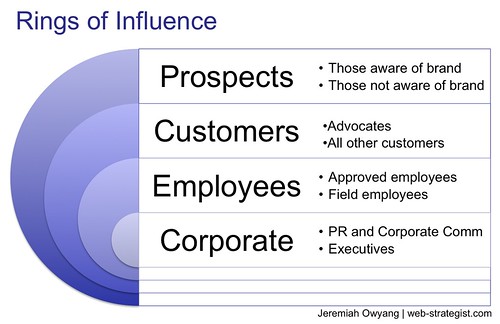
In order to scale in both time and mass, corporations must now extend their communication strategy beyond just corporate communications and sanctioned ‘company representatives’ to include the other rings in their communications mix. In the following graphic, the “Rings of Influence” I’ve mapped out how other roles can and should be used in the communications strategy. I’ve worked on trust research, and found that in most cases the closer in the rings (corporate) there’s less trust. Other studies, like Edelman’s 2010 trust barometer indicate similar findings as the most trusted relationships are at the outer rings, see figures 7 & 8 in this PDF.
Framework: Rings Of Influence
As brand embrace the larger circles, the greater opportunity for reach, trust –and risk. I hope you use this graphic in your planning docs and presentations, it’s licensed under creative commons as Attribution-NonCommercial-ShareAlike Creative Common. Graphic assistance by Christine Tran, @christineptran
| Role and Description | The Opportunity: | Who’s Doing It Right: | What no one tells you: |
| Prospects: Those that are not yet customers. | Engaging soon-to-be-customers during their problem and pain stages and focusing them on your solutions is the goal. | Build lifestyle communities to engage them in a ‘bigger-than-brand’ discussion such as CVS’s community for caretakers. | You’ll really need to let go of hard marketing styles and focus on what IBM’s senior marketer Sandy Carter calls “light branding.” Make sure you have a community kickstart plan. |
| Customers: Existing buyers, some which are highly engaged and vocal in your space. | Enabling the voice of the customer has been a mainstay belief for product development, but most companies have not harnessed them for marketing and support. | Build an active advocacy program that encourages them to fight your own battles like Intel Insiders, Microsoft MVP, Wal-Mart’s 11 moms program. Bazaarvoice enables companies like BestBuy to have ratings and reviews on their site –increasing flow through funnel | Customers will love and hate you alike. If you harness their voices, expect to let both types of information come through in a strategic way. The trick? Use complaints as an opportunity to show openness and customer response in public. The savvy brands will trigger advocates to deal with detractors, use this checklist to get started. |
| Employees: Rank and file as well as ‘approved employees’ who are blessed to use social tools. | Regular rank and file employees that are knowledgeable about products and are close to customers are likely to be more trusted than veneered executives. | Give your own rank and file the opportunity to voice their opinion like Premier Farnell gave many of their employees the ability to publish their own videos on a community like Element 14. | Employees need guidelines, training, and processes. Don’t leave your company or your employees exposed, develop internal training programs, regular communications, and a place to share. See how Intel has created a light weight ‘certification’ program for employees who participate in social |
| Corporate: The traditional and centralized communications group and sanctioned executives | Corporate comms can benefit from social tools that allow the spread and sharing of company messages, and they can also build a social platform to stand on in order to fend of critics | See how SouthWest Airlines has built a corporate blog for years, which gave them the standing power to fight back against detractor Kevin Smith. Also, see how Domino’s President used online video to respond in a human and more trusted way during an employee health crises. | Lots of retraining when it comes to rethinking the approach in this space. Stop and breath, develop a measured set of steps a framework, control is not completely lost if you have a balance. This is an opportunity more than a threat. |
Harness All The Voices In Your Ecosystem –Not Just Corporate Communications
Brands should stop focusing on the corporate ring alone –and benefit by using all the rings in a coordinated fashion. I’ve broken down the roles into subsets in the above matrix, yet there are some key baseline considerations as your deploy, remember to:
- Recognize that greater opportunity is abound at outer rings –but comes with increased risk. Brands are most comfortable operation in the inside rings, like ‘Corporate’. Yet the greatest opportunity to leverage trust and reach happens at the outer rings of influence with ‘Customers’ and ‘Prospects’. Of course, with a greater benefit comes greater risk as there’s less control over conversations on the outer rings.
- Map the rings to your existing customer experience timeline. These rings aren’t unlike traditional marketing funnels, except that there’s a focus on role and trust, over cycle. In most cases, prospects are in the outer mouth of a funnel, but customers, employees, and corporate can also participate in every step of the marketing funnel. Analyze which roles are needed in what aspects of the customer timeline –and map your strategy accordingly
- Analyze your existing social marketing programs. From Facebook, community, Twitter, to Gowalla, brands must take inventory of each of their existing social programs. Pull out a spreadsheet and map which each of your social media programs are doing, look at both: 1) Which ring is the primary publisher, 2) Which ring are they trying to reach.
- Be pragmatic, and develop a roadmap: start with smallest ring and move out. Don’t jump on the largest ring of prospects without first getting grounded. Start at the inner circle and work your way out, by building a foundation at the core and building on success and safety in experience. Companies that try to address prospects but lack the internal resources and ethos to deliver may find themselves offering false promises.
This single graphic represents an entire presentation I’m developing for internal client workshops or keynote presentations at marketing and business conferences. I love to share, and want to get your feedback in the comments below so I can improve it. Update: Mitch has also extended the conversation in the Social CRM pioneers Google Group, watch it unfold and participate in the group.

Really like how you've put this together Jeremiah. This network thinking or thinking about how you can influence the influencers of your targets is really critical. Almost all behavior studies that I've seen from getting kids to eat their peas to counteracting bullying to changing corporate culture stress that the most sustainable way to change behavior is to get peers to model the behavior you would like to see. So finding the peers of your targets most likely to model the behavior you want to influence is absolutely critical.
Really like how you've put this together Jeremiah. This network thinking or thinking about how you can influence the influencers of your targets is really critical. Almost all behavior studies that I've seen from getting kids to eat their peas to counteracting bullying to changing corporate culture stress that the most sustainable way to change behavior is to get peers to model the behavior you would like to see. So finding the peers of your targets most likely to model the behavior you want to influence is absolutely critical.
Really like how you've put this together Jeremiah. This network thinking or thinking about how you can influence the influencers of your targets is really critical. Almost all behavior studies that I've seen from getting kids to eat their peas to counteracting bullying to changing corporate culture stress that the most sustainable way to change behavior is to get peers to model the behavior you would like to see. So finding the peers of your targets most likely to model the behavior you want to influence is absolutely critical.
Jeremiah, Great post as usual. One question: are you suggesting that companies should have a different strategy for reching each of the rings, or rather that all of the rings should be included in the social strategy? The examples you provide seem to point to the former, but in my experience, most companies need to focus on a particular strategy at least early on. I'd love to hear your take.
Jeremiah, Great post as usual. One question: are you suggesting that companies should have a different strategy for reching each of the rings, or rather that all of the rings should be included in the social strategy? The examples you provide seem to point to the former, but in my experience, most companies need to focus on a particular strategy at least early on. I'd love to hear your take.
Jeremiah, Great post as usual. One question: are you suggesting that companies should have a different strategy for reching each of the rings, or rather that all of the rings should be included in the social strategy? The examples you provide seem to point to the former, but in my experience, most companies need to focus on a particular strategy at least early on. I'd love to hear your take.
Jeremiah, thank you, a really great post.
I think there is a missing part after the sentence “This gap in ability to scale and traditional t”
Jeremiah, thank you, a really great post.
I think there is a missing part after the sentence “This gap in ability to scale and traditional t”
Jeremiah, thank you, a really great post.
I think there is a missing part after the sentence “This gap in ability to scale and traditional t”
Great presentation. I like your comments very much. It perfectly fits to my presentation and blog posting Social Media is everybody in the Enterprise – And Controlettis: You have already lost. Sorry, a German language blog posting.Thank you.
Great presentation. I like your comments very much. It perfectly fits to my presentation and blog posting Social Media is everybody in the Enterprise – And Controlettis: You have already lost. Sorry, a German language blog posting.Thank you.
Great presentation. I like your comments very much. It perfectly fits to my presentation and blog posting Social Media is everybody in the Enterprise – And Controlettis: You have already lost. Sorry, a German language blog posting.Thank you.
I'd like to hear you expand on this point: “Companies that try to address prospects but lack the internal resources and ethos to deliver may find themselves offering false promises”.
That's a pretty important statement: all your social efforts could be derailed if you find yourself in that situation. What kind of false promises do you mean? What internal resources need to be in place to deliver on promises?
Excellent article, Jeremiah!
I'd like to hear you expand on this point: “Companies that try to address prospects but lack the internal resources and ethos to deliver may find themselves offering false promises”.
That's a pretty important statement: all your social efforts could be derailed if you find yourself in that situation. What kind of false promises do you mean? What internal resources need to be in place to deliver on promises?
Excellent article, Jeremiah!
I'd like to hear you expand on this point: “Companies that try to address prospects but lack the internal resources and ethos to deliver may find themselves offering false promises”.
That's a pretty important statement: all your social efforts could be derailed if you find yourself in that situation. What kind of false promises do you mean? What internal resources need to be in place to deliver on promises?
Excellent article, Jeremiah!
I enthusiastically agree with this kind of model (Jacob's and Guy's). I made one based on the Smith Butterfly diagram typically used for visualization of electrical and magnetic fields. http://cli.gs/e8MpbL
I enthusiastically agree with this kind of model (Jacob's and Guy's). I made one based on the Smith Butterfly diagram typically used for visualization of electrical and magnetic fields. http://cli.gs/e8MpbL
I enthusiastically agree with this kind of model (Jacob's and Guy's). I made one based on the Smith Butterfly diagram typically used for visualization of electrical and magnetic fields. http://cli.gs/e8MpbL
Your sphere of influence is spot-on, but needs one enhancement ¦. Retirees are very important in the sphere of influence, former employees can be strong advocates for your brand and key influencers in their communities or professional arena. This can be taken further into retirees mentoring current employees so that it increases retention and incremental employee efforts, generating additional customer loyalty and incremental product and service sales. Outreach through social media allows retirees to be heard, promotes positive interaction and instills confidence in the mother company. An example of HP retirees getting engaged is on Facebook http://www.facebook.com/hpretiree
We also have a big LinkedIn presence with former employees creating more than 150 groups and forums.
Your sphere of influence is spot-on, but needs one enhancement ¦. Retirees are very important in the sphere of influence, former employees can be strong advocates for your brand and key influencers in their communities or professional arena. This can be taken further into retirees mentoring current employees so that it increases retention and incremental employee efforts, generating additional customer loyalty and incremental product and service sales. Outreach through social media allows retirees to be heard, promotes positive interaction and instills confidence in the mother company. An example of HP retirees getting engaged is on Facebook http://www.facebook.com/hpretiree
We also have a big LinkedIn presence with former employees creating more than 150 groups and forums.
Your sphere of influence is spot-on, but needs one enhancement ¦. Retirees are very important in the sphere of influence, former employees can be strong advocates for your brand and key influencers in their communities or professional arena. This can be taken further into retirees mentoring current employees so that it increases retention and incremental employee efforts, generating additional customer loyalty and incremental product and service sales. Outreach through social media allows retirees to be heard, promotes positive interaction and instills confidence in the mother company. An example of HP retirees getting engaged is on Facebook http://www.facebook.com/hpretiree
We also have a big LinkedIn presence with former employees creating more than 150 groups and forums.
sports shoes
Nike Sport Shoes
Women's Nike Sport Shoes
Men's Nike Sport Shoes
sports shoes
Nike Sport Shoes
Women's Nike Sport Shoes
Men's Nike Sport Shoes
As we know that rings are very important for the engagement. So, here you explain very well to choose best Rings. Really I want to buy good rings for my girlfriend.
I like this article, I think this article is very level. Whether the content, or structural arrangements are very good. I believe some spent a lot of effort on it!embroidery design,embroidery designs,rapid prototyping,
plastic molds,product design,plastic molding
I like this article, I think this article is very level. Whether the content, or structural arrangements are very good. I believe some spent a lot of effort on it!embroidery design,embroidery designs,rapid prototyping,
plastic molds,product design,plastic molding
Good stuff . Keep it up.
great article, thanks for sharing!