Lolo 3 weeks ago
53

Diagram: How the Air Force Response to Blogs

Categories: Social MediaPosted on December 31st, 2008

The Airforce has created a process flow diagram that indicates very succinctly how the Air Force can and should respond to blog posts, there’s a lot to learn from here, and for the most part, I try to follow these similar rules. The Airforce, well all military units across the globe come across criticism, so establishing a clear sense of communication guidelines.

Thanks to Joey DeVilla for posting this, who learned of this from David Meerman Scott who was in contact with Capt. Faggard who’s involved with the Airforce’s social media team: Twitter, and a blogspot blog, (I’m surprised they don’t have their own blog on the airforce websites, so we’re going off David’s word that this is authentic)

There’s a lot to be learned from this military diagram that can be applied to corporations or even your personal blogging efforts.
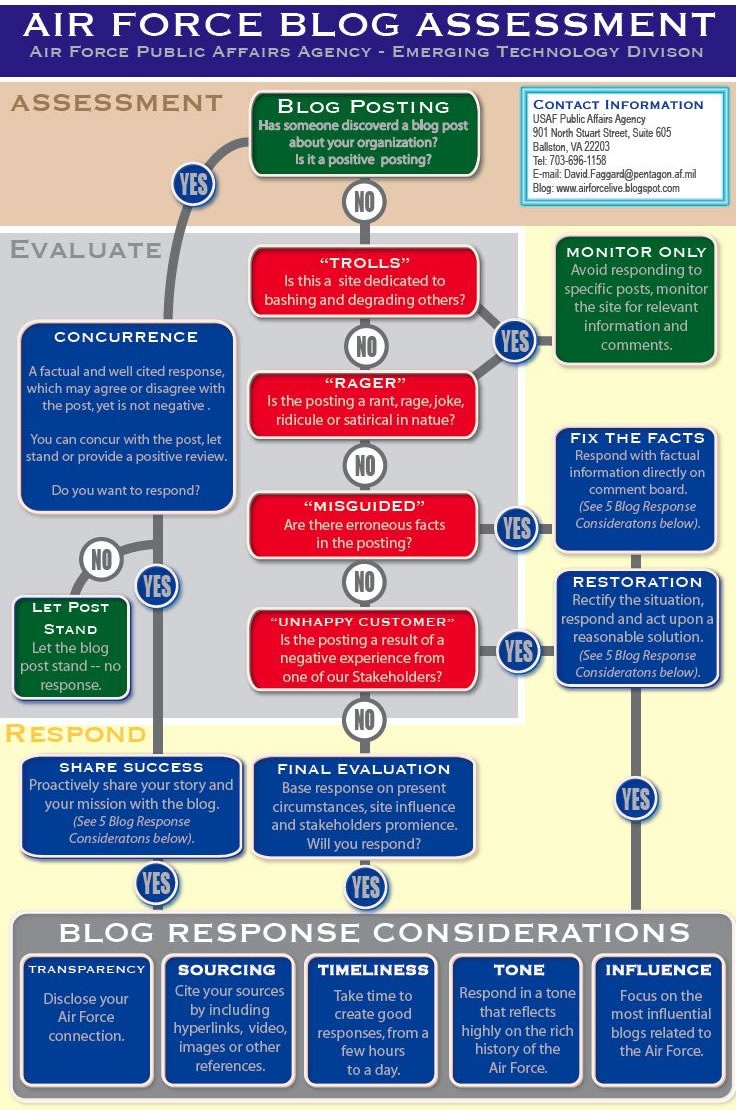
Air Force Blog Assessment

On a personal note, my Grandfather was a decorated Lieutenant in General Patton’s 9th Army AirForce station in Europe in WW2, he flew a P47 Thunderbolt, and was one of the very few Chinese American pilots in the war. You can see clippings of an article that featured him (the beautiful lady is my Grandmother). The plane? He named it after his hometown here in Silicon Valley the “San Mateo Belle”.

Share This Post:
  • Digg
  • del.icio.us
  • Facebook
  • Google Bookmarks
  • Reddit
  • Technorati
  • LinkedIn
  • FriendFeed
  • StumbleUpon
  • Twitter

53 Responses to “Diagram: How the Air Force Response to Blogs”

  1. I particularly like the transparency and sourcing considerations.

    The only thing I would change is “Has someone discovered…” to “Have you discovered…”.

    That might not work for the Air Force where mission confidentiality is an issue, but for most companies any employee should be able to speak up on behalf or their organisation.

    It doesn’t always need to come from a PR department.


  2. Fascinating piece, thanks for posting!


  3. [...] December 31, 2008 by Beacon Hill NW Diagram: How the Air Force Response to Blogs. [...]


  4. nice piece Jeremiah! Dow Jones works with the PR agency, RMG Connect, that put the social media strategy in place for the Marine Corps Recruting effort. If you wish to learn more, I can connect you to my contact. We have been working with this account for three years and find it an evolving strategy to mirror the change in landscape in social media(and hence the conversation) with the MCRC efforts.
    We are in the process of publishing an ebook on the subject and I will be happy to send a link to you when it is ready for primetime.
    Happy New Year!
    Sally


  5. Hey Jeremiah,

    I did indeed have a conversation with Capt. Faggard about everything he’s up to at the Air Force (and reported it on my blog). I was thrilled to have had a chance to speak with him. Yes, the assessment tool is legit and he gave me permission to post if.

    Take care, David


  6. While I think it’s good to put a process together for companies who don’t get social media; I think this flowchart questions the very purpose of social media.

    Social media is more than just a “positive” or “negative” perspective on blogs. I see nothing on there to elevate feedback throughout the organization, nothing on effecting change, nothing on proactively sharing information, nothing on engaging with the online community.

    This diagram is a cheat-sheet for old-school PR folks who rely on process flows, rather than just being themselves and having a genuine human interest in the conversation. Social media is not a process, a checklist, or a Venn diagram. It’s a culture change.

    ~Joe


  7. Sally thanks! Yes, please connect me with them, that’s interesting to me.

    David, thanks for the clarification, I always am skeptical now a days, after the Janet fiasco.


  8. “…Focus on the most influential blogs that relate to …”

    I have another critique on this diagram.
    Every blog deserves the same amount of respect for a response. I don’t care if it’s on the Huffington Post or blog on MySpace, people are people and they all deserve the same respect, regardless of their “influence.”

    My point is that every person can influence and cite change


  9. Joe

    You’re right, each of these boxes has additional weight that has be measured, nothing is really black or white.

    The important thing to remember is that having this process diagram is better than not having it as a resource.

    It’s a step forward.

    What would make this process work best? If there was a centralized group within the airforce that bloggers or commenters could go to at anytime for advice.


  10. I’d recommend that USAF invest and fundamentally support a social media strategist to assess their social media engagement on both a immediate, intermediate and long-term plan. I think immediately, it’s to communicate more (besides throwing images up on a blogger page…).

    Perhaps taking their critiques and responding to them instead of merely silencing bloggers by feeding them a comment to quell their views.

    Understand that my critique is not necessarily aimed toward you or the USAF. It’s directed for your readers who printed this out and who might follow it religiously.

    I find this is a great start; but should be cautioned that it’s an outline but doesn’t cover every circumstance for which the USAF participates social media. People need to hold this diagram with respect to the fact the USAF is extremely guarded with information release and disclosure. It’s good, but shouldn’t be posted in every office. ;-)

    ~Joe


  11. That’s really smart. Especially how many big organizations don’t know or have a real strategy on responding to negative post/feedback. Don’t want to feed those trolls or raging people.


  12. interesting piece about your grandpa. love the pinup shot :)


  13. I don’t have much to add to the comments and builds on this document but I will say that what impresses me here is that this is great information design. So many times you see guidelines (and to Joe’s point – these should be understood as guidelines NOT fixed policy) written in dry text that ensures no one will read it, much less follow it. These guidelines are designed to be immediately intelligible.

    All told, there is a lot of information here – including educational info about the culture of the blogosphere (trolls etc.). Yet it is immediately accessible, understandable and actionable. It is not enough to create guidelines within a large organization… you need to organize the information so that it is meaningful… Nice work.


  14. [...] Diagram: How the Air Force Response to Blogs Funktioniert so oder in ähnlicher Form auch für die meisten Unternehmen. (tags: socialmedia pr blogging blogs groundswell via:mento.info) [...]


  15. [...] “How the Air Force Response to Blogs” beschreibt in einem schönen Diagramm, wie die Air Force mit Blogs umgeht. Ich wusste bisher nicht, dass die Air Force ein Social Media Team hat. [...]


  16. [...] Continued here: Diagram: How the Air Force Response to Blogs [...]


  17. [...] Web Strategy by Jeremiah: How the Air Force Responds to Blogs [...]


  18. Thanks Jeremiah …

    This is very cool to see. I’m sure there are plenty of these types of things out there, but i’ve not seen any diagramed out this well.

    It’s a perfect example and helps answer a ton of common questions … like “How do we ‘control’ what’s being said about us out there?”

    There are obviously many more elements to social media, but this is a nice practical way to guide peoples thinking and allow organizations to have a starting point.


    http://twitter.com/franswaa


  19. As the minister in the UK government responsible for digital engagement, this is a fantastically helpful post – thank you!


  20. [...] they have a very helpful military-style flow chart that might be useful for UK civil [...]


  21. [...] on his web strategy blog Jermiah Owyang has posted a great flowchart for the USAF on how they should respond to blogs. Of [...]


  22. [...] air force respond to blog posts Jan 2nd, 2009 by Tom Watson MP. Well they have a very helpful military-style flow chart that might be useful for UK civil [...]


  23. [...] comes (in the usual roundabout way) from this fascinating investigation by David Meerman Scott into how the Air Force is [...]


  24. [...] via the web strategist and blog supremo Jeremiah Owyang, although created for use by the US Air Force, it could just as easily be applied to business or [...]


  25. [...] Diagram: How the Air Force Response to Blogs The Airforce has created a process flow diagram that indicates very succinctly how the Air Force can and should respond to blog posts. (tags: socialmedia blogging airforce guidelines response) [...]


  26. [...] Diagram: How the Air Force Response to Blogs Simple guidelines that would help any public sector body ensuring consistent communication (or any organisation with a public profile). [...]


  27. [...] size version here.  H/t Jeremiah Owyang, via Tom Watson. Send this article to: Hide Sites « [...]


  28. [...] U.S.-Airforce hat ein paar ziemlich gute Richtlinien für sich entwickelt wie man mit Blogposts umgehen [...]


  29. This is a great guideline. Thanks for posting.


  30. [...] many of the other branches of service. Their official blog is hosted on blogger though. Thanks to Jeremiah for his original post on this [...]


  31. A fascinating tool, maybe a bit one sided though. But well, it was done by a military organization.


  32. [...] Diagram: How the Air Force Response to Blogs Unlike many diagrams in the world, I actually understand this one. (tags: forblog blogging socialmedia jeremiahowyang) [...]


  33. [...] The flowchart isn’t perfect but its bloody good and certainly gives people a quick primer of how they should deal with social media and where and when they should act themselves or pass it on.  Anyway take a look – I think its a really useful resource. (I originally found out about this from someone on Twitter who I am afraid I have forgotten who – however the first blog I read about it on was http://www.web-strategist.com/blog/2008/12/31/diagram-how-the-air-force-response-to-blogs/) [...]


  34. What I find interesting is the whole assessment/flow-chart approach. I’ve never been in the military but I imagine that similar decision trees are used for other types of decision making/situations that require a reaction/response (of course, those decisions and thought processes probably occur in a matter of a split second). I believe the idea is to have a guide and then the reaction or next step decision should start to become second nature and if appropriate, maybe a little “shooting from the hip” (within the military-communication protocols). Citizen journalism and more loose communication methods can be uncomfortable for certain organizations.


  35. Posted by lpaul on January 7th, 2009 at 11:30 am
  36. Hello Jeremiah. Another excellent piece of shared knowledge. Thank you. I’ve taken the liberty of translating it to Swedish, with some changes – making it a bit more general: helps and tips for responding to any comments about your company/organisation on the net. Of course I’ve cited the source in all representations of the diagram. Cheers.


  37. [...] trata de guiar los primeros pasos por la blogosfera. Y ese dibujo es parecido al que encontre vía Jeremiah Owyang hace unos días. Así que lo he pasado a castellano, le he dado el correspondiente toque personal y [...]


  38. [...] Jerimiah posts about the Air Force’s approach to responding to blog [...]


  39. [...] Per Axbom har översatt ett diagram om hur man kan svara på kommentarer runt sitt företag på nätet. Ursprungligen kommer diagrammet från amerikanska flygvapnet och snappades upp av Jeremiah Owyang på Forrester. [...]


  40. [...] this over at Jeremiah Owyang’s site. It’s a great diagram and a model for how MP offices, politicians, and corporations should [...]


  41. [...] To be able to do so, you’ll have to learn to actively participate and interact in those spaces first. [...]


  42. [...] 23 January, 2009 When sifting through my Web and Enterprise 2.0 folder I found this gem on Jermiah Owyang’s blog.  – To give credit where it is due here’s the credit as stated by Jermiah: Thanks to Joey [...]


  43. [...] interest in the web response assessment chart and feedback from people such as David, Joey deVilla, Jeremiah Owyang, Steve Field, Matt McGee and others – Captain Faggard, Chief of Emerging Technology at the Air [...]


  44. [...] personally like this handy chart I recently found (via Twitter, I believe, but the h/t goes to Web Strategist).  It’s from an organization that knows a thing or two about “handling [...]


  45. [...] Paine got this chart from Jeremiah Owyang who got it from Joey Devilla who found out about it from David Meerman Scott – so I’m relying [...]


  46. Air Force Offers Guidance on Blog Comments…

    In light of M&M writing a blogging white paper for Air Force, I thought this link would be of interest. Apparently Air Force published a short and sweet flowchart advising folks on how to handle blog posts about the Air Force…….


  47. [...] many of the other branches of service. Their official blog is hosted on blogger though. Thanks to Jeremiah for his original post on this [...]


  48. [...] to conversations. Which conversations will you engage in? Which ones will you simply listen to? The US Air Force blog response chart is a great starting point for this side of things, though you may want to amend this for your [...]


  49. [...] from an internal component – a clearly-defined process for how to go about those interactions. The US Air Force has a well thought-out decision tree that lays out the considerations for whether to respond to posts. You may want to tweak it for your [...]


  50. [...] personally like this handy chart I recently found (via Twitter, I believe, but the h/t goes to Web Strategist).  It’s from an organization that knows a thing or two about “handling [...]


  51. [...] The US Air Force’s social media strategy [...]


  52. [...] processes around social web and he points quickly to the military. In his case, he pointed to the US Air Force’s response roadmap. (BTW, The US Army has one [...]


  53. [...] stukje van Koen Roozen, over hoe je in zulke situaties kunt reageren. Het model is gemaakt door  Jermiah Owyang en dank aan hem [...]


Leave a Reply

Or enter your details below:


site design by studionashvegas proudly powered by WordPress