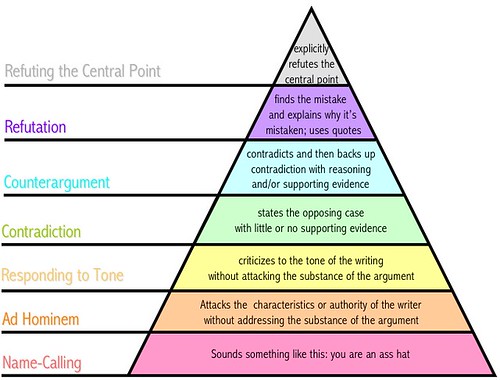
As an analyst, we undergo training then are put to the test to stand by our calls, and back it up with data, insight, experience, or facts. I found this diagram published by the create debate blog, and by using the creative commons license they have on their blog, am sharing it with you. The graphic is spurred by the essay written by Paul Graham How to Disagree, start there.
Since I tie just about everything back to internet strategy, let’s take this fictional example of one of your colleagues who has spent significant budget on advertising popups on a C rated media site in your market. You, the social media strategist at your company, is less than thrilled to see this, but you need to think about different ways to approach this
Using Graham’s Hierarchy, here’s some fictional arguments you could use to persuade your colleague with the advertising-popup plan:
Refuting the Central Point: Regarding your advertising-popup tactic, we should refocus our core strategy on using marketing channels that allow us not only tell our message, but leave prospects with a positive brand impression, and the desire to take the next step with us. (notice that I focused on the objective, without even criticizing the popups, nor the person)
Refutation: I’d like you to reconsider your advertising-popup tactic, as most users don’t like them, in fact Treester Research shows that 26% of those who see popups actually have a negative brand impression.
Counterargument: Advertising-popups are a bad idea, research indicates most users don’t like them
Contradiction: Everyone knows advertising-popups are a bad idea
Responding to Tone: It sounds like you’re frustrated and don’t know what to do
Ad Hominem: So typical of you people to do something stupid
Name-Calling: Your advertising-popup strategy sucks buttocks, ass hat
Caveat: I’m not slamming the pop-up marketing industry, this is just an example, I could have used blogs too.
I remember as a child, the school yard arguments were often at the bottom. Sadly, some bloggers and tweeters are still there. When you talk to executives, I recommend you focus on the end objectives and end results, never on the tools, which moves lower and lower on the pyramid.
So, back to you, what point on the pyramid do you insert your arguments? Be honest, and talk about how you can improve or give an example.
(for what it matters, I quickly fall down the pyramid when I’m dealing with my loved ones, I’m certainly a guilty ass hat)
This entry was posted on Thursday, May 22nd, 2008 at 5:28 am and is filed under Career, Social Media, Web Theory. You can follow any responses to this entry through the RSS 2.0 feed. You can leave a response, or trackback from your own site.
23 Responses to “How do you Argue?”
Leave a Reply
- Advertising
- Aggregation
- Analyst
- API
- Asia
- Blogger Dinner
- Career
- Case Study
- Challenges
- Citizen Journalism
- Collaboration
- Community Manager
- Community Marketing
- Conference
- Content Management System
- Content Management Systems
- Curated Social Content
- Data Portability
- Data Storage
- Digest
- eCommerce
- Economy
- Enterprise Web
- Ethics
- Europe
- Events
- Extranet
- Facebook Strategy
- Fansumer
- FAQ
- Feedback
- Forrester
- Funding
- Future of Social Web
- Generations
- Geo Tagging
- Global Web
- Groundswell
- Hitachi
- Hitachi Data Systems
- Identity
- Industry Index
- Information Architecture
- Intelligent Web
- Interactive Marketing
- Interview
- Intranet
- IPTV
- IT
- Job Survey
- Live Video
- Mashups
- Media 2.0
- Microformat
- MicroMedia
- MicroMeme
- Mmorpg
- Mobile
- MySpace
- Non Profit
- On the move
- OpenSocial
- Other
- Personalization
- Platform
- Podcasts
- Podtech
- Politics
- Pollination
- PR
- Privacy
- Process
- Publication
- Quicktake
- Reading Sampler
- Rich Media
- Ruminations
- Search Strategy
- Second Life
- Security
- Silicon Valley Sightings
- Social CMS
- Social Computing
- Social CRM
- Social Graph
- Social Media
- Social Media Job
- Social Media Measurement
- Social Media Services
- Social Media Stats
- Social Networking
- storyboard
- Sustainable
- Syndication
- Technographics
- Technology
- Travel
- Trends
- User Experience
- VCs
- Venture Capital
- Video
- Virtual World
- Voice of the Customer
- VoIP
- Walkthrough
- Web Advertising
- Web Analytics
- Web Design
- Web Industry
- Web Law
- Web Marketing
- Web Strategy
- Web Strategy Show
- Web Team
- Web Theory
- Web Tools
- Web Usage
- White Label Social Network
- Widget Strategy
- Wireless
- Word of Mouth
- Word of Mouth Marketing
- July 2009
- June 2009
- May 2009
- April 2009
- March 2009
- February 2009
- January 2009
- December 2008
- November 2008
- October 2008
- September 2008
- August 2008
- July 2008
- June 2008
- May 2008
- April 2008
- March 2008
- February 2008
- January 2008
- December 2007
- November 2007
- October 2007
- September 2007
- August 2007
- July 2007
- June 2007
- May 2007
- April 2007
- March 2007
- February 2007
- January 2007
- December 2006
- November 2006
- October 2006
- September 2006
- August 2006
- July 2006
- June 2006
-
Jobs for the Web Strategist- Copywriter (part time) at Carroll Enterprises, Inc. (Worcester, Massachusetts)
- Social Media Project Manager at Creative Labs, Inc. (Milpitas, California)
- Director of Social Media Marketing at PTC (Massachusetts)
- 2166 Global Digital Communications Manager at Ford Motor Company (Dearborn, Michigan)
- Online Connection Pastor at LifeChurch.tv (Edmond, Oklahoma)
- Search Marketing Analyst at OWN: The Oprah Winfrey Network (Los Angeles, California)
- Fees from these job postings pay for web hosting
-
My Flickr Photos
About
Jeremiah Owyang
Silicon Valley
The views expressed on this website/weblog are mine alone and do not necessarily reflect the views of my employer, Forrester Research.


Appreciate the article as a reminder of the “right” way to communicate effectively. Depending on the subject matter and opponent, I admit I fluctuate. My kids are where I find the most difficult. Too often my argument degenerates to “Because I said so!”
Posted by RosePena on May 22nd, 2008 at 6:06 am
I’d be interested in a hierarchy of ‘ways to agree’.
The lowest level is the ‘Abilene Paradox’ where everyone verbally agrees on a course of action while disagreeing internally. At the higest level everyone involved might understand the core purpose behind the agreed-upon action.
For what it’s worth I spend too much time in contradiction and not nearly enough in counterargument or above. But I haven’t called anyone an ass hat yet today. We’ll see if that holds after I have my annual merit conversation with my manager
Posted by rsomers on May 22nd, 2008 at 6:12 am
Rose
It’s normal, emotions cause us to quickly fall down the pyramid, I’m so guilty.
Posted by jeremiah_owyang on May 22nd, 2008 at 6:20 am
rsomers
glad this was a healthy exercise, I need to work on this too. Analyst get asked to defend their work, so I need to perch nice and high.
Posted by jeremiah_owyang on May 22nd, 2008 at 6:21 am
I find that certain ‘cyclical’ arguments within companies usually start at the top of the pyramid, but with time soon fall to the bottom as we’ve argued the point countless times; ending up with the Ad Hominem or Name Calling as the default response.
Posted by lukeperman on May 22nd, 2008 at 6:28 am
Trying to start as high on the pyramid, and sadly, as emotion and or exasperation kicks in, sliding down…
Great graph, will share with my team if I see another example of bottom end of the pyramid discussions going on
Posted by Marc Dierens on May 22nd, 2008 at 6:56 am
Marc
Thanks for passing it around the Sun team blogs, that’s great news.
I can’t believe no one got my “Treester Research” joke.
Posted by jeremiah_owyang on May 22nd, 2008 at 6:59 am
we all got Treester, Jeremiah, but were too cool to say anything;-)
I don’t enjoy conflict,and feel very uncomfortable having to argue my point, even though, when it comes to new media especially, I have a lot of experience (meaning, at very least, mistakes that I can help clients avoid).
so, the top of the pyramid is actually much more comfortable for me, not because I’m so evolved (heaven forfend!), but just because the conversation may be able to stay calm and clear of drama.
I shared this with one of my favorite progressive politics blogs: didn’t get comments, but I bet it got people thinking, as the bottom level is a big problem in that area…
tks. for this!
Posted by Terri in Tokyo on May 22nd, 2008 at 7:08 am
A field of study I deeply resonate with is conscious communication. This piramid seems to stay in a ‘reactive’ mode in all cases not living space for empathic and much less generative modes of listening and speaking. Critize, contradict, opose, refutation…what about open mind, heart and will for discovering what ‘truth’ is in the perspective of the other. And letting the words weave, resonate, expand and create the new. Much studies have been done here in the work of Otto Scharmer and Fred Kofman for transforming our culture and ‘Conscious business’.
Posted by Fernanda Ibarra on May 22nd, 2008 at 7:16 am
Great article. I consistently fall into the 2nd category when trying to present an alternative or a reason for change at work. However, the elegance of the top of the pyramid seems much more likely to be effective. I definitely learned something from this post and will try to make this change. Not sure how easy that will be though.
Posted by Carri on May 22nd, 2008 at 7:24 am
Terri
At least someone got my joke. thanks. for the golf clap…I think.
Posted by jeremiah_owyang on May 22nd, 2008 at 7:50 am
Gillmor Gang: vacillates between ass hat calling and contradiction, often limping into ad hominem. That’s why it is so funny. GG is a perfect example of when outsiders get to overhear insiders arguing. I hope it never changes, because it *is* funny, but if it were really important it would be an object lesson.
Posted by francine hardaway on May 22nd, 2008 at 7:52 am
I like where Fernanda Ibarra is going with her comment. As I’ve aged I’ve learned that you get a lot farther when you avoid the bottom of the pyramid so I probably respond with levels 2 or 3 most of the time. I think the difference is focusing on the positive about the people involved and finding a more positive solution to a situation. Think positive!
Posted by Janie Graziani on May 22nd, 2008 at 8:30 am
Jeremiah,
I think this structure misses the key point that your colleague has already taken a position and simply arguing against it will rarely work unless he/she has the most analytical/logical personality.
In this situation I would:
1)try to determine the motivation of his/her strategy - what are the goals;
2)Understand how they feel pop ups accomplishes that goal;
3)Use a question based approach to help that person lead themself to a better answer (this is an art that comes with a lot of practice).
By allowing your colleague to come to the conclusion on their own, they are more likely to shift to your perspective.
Posted by Trevor Speirs on May 22nd, 2008 at 9:26 am
If any of you would like to practice using some of these techniques in an environment with much less severe consequences than work, I suggest you check out the site that posted the argument hierarchy. It’s called CreateDebate (www.createdebate.com) and I came across it about 2 weeks ago. A lot of good arguments going on over there (at all levels of the pyramid I might add). May be worth checking out to improve your argument skills for more consequential environments.
Posted by Frank Bennett on May 22nd, 2008 at 9:55 am
Great post, Jeremiah
Since I mostly work with media organizations (which means taking into account their audiences, communities, and advertisers/funders) I find it helps to simplify discussions by considering: what does the audience/community want, need, prefer, or expect? Because in media, if it doesn’t work for the audience/community, the business doesn’t work for anyone.
That’s also a useful perspective for advertisers to consider — which is why I wish they’d focus more on crafting relevance… but that’s another battle to fight…
Of course, it’s important to realize whether you really need to persuade whoever you’re talking to. Some people approach every discussion as something to “win.” Often, it’s more important to just listen and understand someone else’s perspective or ideas. In other words, I think the very first step in the process you outline above is to ask the question: Do I really need to construct an argument here, or just listen?
- Amy Gahran
Posted by Amy Gahran on May 22nd, 2008 at 10:18 am
Trevor
Good points, it always makes sense to be a bit sensitive and lead others rather than push them.
Posted by jeremiah_owyang on May 22nd, 2008 at 12:02 pm
You said, “As an analyst, we undergo training then are put to the test to stand by our calls, and back it up with data, insight, experience, or facts.”
That’s a great way to make sure you’re on the right track. However, what I’d then ask is this really great interview questions I’d faced once…
“What were the last 3 - 5 times you were wrong?” So, even with all the backup data, testing, etc. what were the last few times you or Forrester had made a mistake? I’d think such things are as or even more instructive then initial investigations.
Just curious.
Posted by Scott on May 22nd, 2008 at 12:09 pm
Great post, Jeremiah
Since I mostly work with media organizations (which means taking into account their audiences, communities, and advertisers/funders) I find it helps to simplify discussions by considering: what does the audience/community want, need, prefer, or expect? Because in media, if it doesn’t work for the audience/community, the business doesn’t work for anyone.
That’s also a useful perspective for advertisers to consider — which is why I wish they’d focus more on crafting relevance… but that’s another battle to fight…
Of course, it’s important to realize whether you really need to persuade whoever you’re talking to. Some people approach every discussion as something to “win.” Often, it’s more important to just listen and understand someone else’s perspective or ideas. In other words, I think the very first step in the process you outline above is to ask the question: Do I really need to construct an argument here, or just listen?
- Amy Gahra
Posted by Amy Gahran on May 22nd, 2008 at 12:21 pm
[...] How do you Argue? This is brilliant. Click through to the original essay by Paul Graham, which is very funny and very true. I have to admit that I’m guilty of using the entire pyramid of argument styles at times, although I keep trying for the apex. (tags: blogging) Posted by Sandy Kemsley on Thursday, May 22, 2008, at 7:32 pm. Filed under Links. Follow any responses to this post with its comments RSS feed. You can post a comment or trackback from your blog. [...]
Posted by Column 2 : links for 2008-05-22 on May 22nd, 2008 at 4:33 pm
Not to jump off subject, but your example rings of Cyrano’s list of insults by type.
Posted by Marc Vermut on May 22nd, 2008 at 8:40 pm
What an ass hat post! ;-}
Posted by Steve on May 23rd, 2008 at 11:56 pm
I still dont get how to make a debate arguement??
This still dont tell me nothing!!
Posted by Jasmine on November 14th, 2008 at 8:24 am